Glory to God (Part 1 of 2)
Ministries > Truth For Life with Alistair Begg
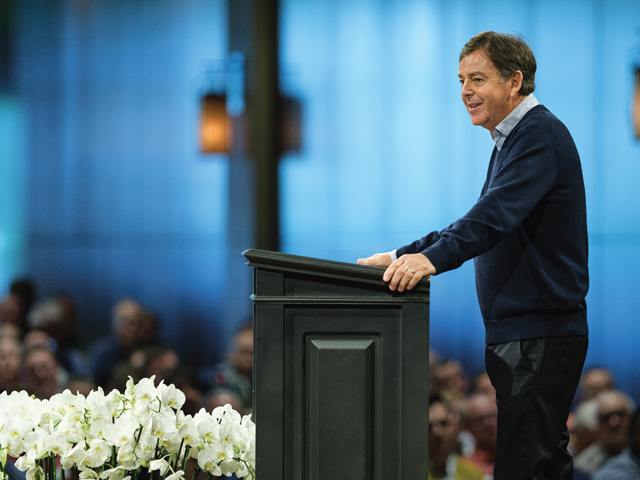
 When you read Scripture, do you think about how it applies to you? Practical applications are important—but not the best place to begin. On Truth For Life, Alistair Begg teaches where you should focus first. It’ll change your perspective on everything else!
-----------------------------------------
• Click here and look for "FROM THE SERMON" to stream or read the full message.
• This program is part of the series A Study in 1 Timothy, Volume 2’
• Learn more about our current resource, request your copy with a donation of any amount.
• In one of the most famous sermons ever preached, Jesus explains that the values in His kingdom are vastly different from the world’s values! The poor will be blessed, those who weep shall laugh, and the hungry will be satisfied. What does this mean? Download the free ebook and study guide The Christian Manifesto by Alistair today at ‘truthforlife.org/manifesto’
Helpful Resources
- Learn about God's salvation plan
- Read our most recent articles
- Subscribe to our daily devotional
Follow Us
YouTube | Instagram | Facebook | X
This listener-funded program features the clear, relevant Bible teaching of Alistair Begg. Today’s program and nearly 3,000 messages can be streamed and shared for free at tfl.org thanks to the generous giving from monthly donors called Truthpartners. Learn more about this Gospel-sharing team or become one today. Thanks for listening to Truth For Life!
Bob Lepine: When you read scripture, are you thinking about what the passage is saying about you or maybe to you? Well, it's good to consider these practical applications, but that's not the best place to start. And today on Truth for Life, Alister Begg explains what our first consideration should always be when we read the scriptures and why.
Alistair Begg: We come to these precious, tender moments when through the voice of a mere man, your voice is heard. And so we pray that you by your spirit will be our teacher, that you will free us from every unhelpful, distracting influence and grant that we might hear your voice and in hearing it obey. For Jesus' sake, we ask it. Amen. Can I invite you to turn with me once again to 1 Timothy and to the 6th chapter? There are two occasions here in this first letter of Timothy when Paul breaks out in a moment or two of spontaneous praise. At least I say there are two which are immediately detectable. We might be able to say that there are more. In each of the two identifiable cases, the issue has to do with the appearing of the Lord Jesus. The first of these comes in the 17th verse of the first chapter when he has made reference to the epiphany, when he is referred to the fact of the glorious appearing of the Lord Jesus who came into the world to save sinners. As he writes of this, his spirit apparently rises within him, and he says in verse 17 now to the king eternal, immortal, invisible, the only God, be honor and glory forever and ever. Amen. And then it happens again as he's drawing his letter to a close here in chapter 6 and in verse 14 as he refers to the glorious appearing of the Lord Jesus Christ, whom he said is going to come as per God's appointed calendar and time scale. It is God, he says, who will bring this about in his own time. And once again, this disclosure gives rise to a spontaneous burst of praise as he provides for us what is a most masterful and lovely doxology. Now it is clear that it is simply out of the abundance of his heart that his mouth is speaking. You read this and you say, I wonder where it was that he got such language, such phraseology to employ in a moment like this. You see, for example, if somebody said, I want you to take seven phrases and use them in praise and honor of God. Now just give them to me immediately out of your lips right now. What would you say? And what you would say would be the product of what you have imbibed over the years, what has been inculcated into your thinking. And so you have this converted Jewish man who had known the benefits of the instruction ala Deuteronomy 6. His parents would have taught him the things of God and the things of the law when he when they walked along the road, when they lay down, and when they got up. And then on the Damascus road, as he walks along that road, he encounters the risen Christ. And suddenly all of the richness of his heritage as a Jewish boy becomes wonderfully clear and plain. And now as he offers worship and glory to God, he employs all these things that he would have known since he was a wee boy. God is the only potentate. He is the only ruler. God is immortally set. God is blessed. He dwells in on approachable light. He is worthy of our honor. He is worthy of our praise. He is the immortal God, and he is the invisible God. You see, nobody can ever give voice to that kind of thing in a vacuum. And that is why it is imperative that we instruct our children as they are growing about the great verities of Christian faith so that as their tiny, malleable minds begin to form, they will be constrained by those essential truths of scripture. They will come to understand that thoughts of God and talk of God is not somehow other superfluous or extraneous to their days, but indeed it is what they will know of God that will give significance to all of their days. Now this is something to which we have to keep anchoring ourselves again and again because at first blush we tend to look, I know I do, at phraseology like this and think that perhaps it's time to move on to verse 17 where there is something of a more pressing and practical import to be considered. Command those who are rich in the present world not to be arrogant. Now we understand the need for that and to that we will come. But the fact is we do a great disservice not only to the scriptures but also to ourselves when we are tempted to think that thoughts of God are somehow unrelated to life and particularly unrelated to our lives, to our laundry, to our family, to our study, to our lab, to our commerce, to our recreation, to whatever dimension of life. The lie of the evil one is that that is a matter that is somehow distanced from everything that is representative of reality. And in point of fact, the instruction of scripture comes to turn our thinking the right way up and brings us face to face with the God of scripture. Who, as Paul mentions him here, is clearly not a cosmic principle, nor is he a figment of the imagination, but he is a self-announcing and self-disclosing sovereign person. Who is God? God is self-announcing, self-disclosing, and sovereign. Now that is vastly different from notions today where God is whatever we conceive of him to be. As someone has cynically put it, when God created the world, he made man in his own image. And when man fell into sin, he determined that he would return the compliment to God, thereby conceiving of God in man's own image. And the problem that many of us face is either that we never think of God or that the God of whom we think is not the God of scripture, a self-disclosing, self-announcing God, a God of revelation, but is either simply some higher force, some cosmic notion, or some personal recreation. Now there is no subject, loved ones, that is so able to humble us where we need to be humbled, to enlarge our minds when they've become puny, to comfort our souls in the midst of great difficulty. There is no subject that is able to do this in the way that a devout consideration of the existence and attributes of God will do. Now for the moment, I know that many of you are processing what I'm saying and some of you are saying, well, maybe, maybe not. I don't know. I'm not sure. He seems to be keen on this idea. I don't know if it's right or wrong. You are at all kinds of levels. I hope before we sing our final hymn that you will be totally convinced that the great, pressing urgency of your life is contained here in verses 15 and 16 of 1 Timothy 6. I want to say three things by way of exposition and three things by way of application. And I want to use words that we have previously used in another context as headings purposefully in the hope that it will simply reinforce times when we have made similar considerations. He introduces us to God here, the blessed and only ruler, the king of kings and Lord of lords. When we think about God as he is revealed in scripture, number one, he is powerful, powerful. He is here the only ruler. You will notice that if you have the King James version, he is the potentate which is of course a potent word. It emerges from potent. And it is a striking statement of the exclusive majesty of the creator God. The powers of earthly rulers are derived from him and they depend upon him. But earthly rulers have no right to rule save that God in the mystery of his providence determined that they may. Now we reinforce this all the time by turning to Isaiah 40. And why should today be any different? If your Bible is open, turn to Isaiah 40. And as you have this notion, he is powerful in your mind. Let's just underscore it. Isaiah 40 in verse 12 speaking of God, who has measured the waters in the hollow of his hand? I just take your hand for a moment and cup it and look at it and ask yourself, how much water can I get in that little hand there? Not a lot. Hardly enough to wash your face with. And it always drink it always goes through your fingers and you have to get it loaded up again. What an amazing picture of the power of God. Think of the Pacific, the Atlantic, the Indian Ocean, the North Sea, the straits of Magellan. Think of them all from geography. Think of all the vastness of those waters. And and the writer says, and God is so powerful, he is so immense that he is able figuratively to pick up all those oceans and hold them in the hollow of his hand. I say figuratively because when it talks about God having a hand, it is an accommodation to our way of thinking because we know that God is spirit, and they that worship him must worship him in spirit and in truth. So when it says he is able to hold them in the hollow of his hand, you are not to think of a of a hand that would be big enough to hold all of the oceans in the world because that will make you giggle a little or it will mesh you up. You won't be able to conceive of a big enough hand. The point is that the principle is there. God is powerful in this way. Who, with the breadth of his hand, marked off the heavens? The people come around your house and they measure things. Some of them are good. They can do it by eyesight. Others pace it off every so often. Some do this thing where they know from their from their wrist to their elbow is so far. I don't know how they do it all. And sometimes they'll say, well, I think that's about X inches. And so if we do that and that and that and that. And some use these gigantic big tape measures that go forever. And they just they hook them on the one end and then they go walking and they and they do all that stuff. I love that stuff. I I don't have anything to measure, but I I love it. And uh you know, and I mentioned I love it in the first service and somebody gave me this in between the services. I don't know. I don't know I don't know who gave it to me, but they I said, you know, I'd like one of those things that you can put on your belt and uh and look like a workman. And uh here I have it. Look at this. With a digital printout. I mean, this this thing is unbelievable. But I I don't know use for it. I don't know what to do. I mean, I got to give this back to whoever gave it to me. I only use a ruler for underlining my notes. I don't know what to do. But even this thing is like 25 ft. Big deal. You couldn't measure much for that. He measures the heavens. You ever mixed concrete? Who held the dust of the earth in a basket? Who weighed the mountains on the scales, the hills in a balance? 15. The nations are like a drop in a bucket. They're regarded as dust on the scales. He weighs the islands as though they were fine dust. He he he looks as it were at the British Isles and he says verse 23. He brings princes to nothing. He reduces the rulers of this world to nothing. Now loved ones, we have to coming out of a week in which our view of ourselves has increased dramatically and our view of God will have been eroded significantly. We have to sit down and reprogram ourselves all over again. We've got to recalibrate. That's one of the reasons for the Lord's day. It's a recalibration process because when you go out and you and you bounce over everything for another seven days and it all works against you. You need to come back and reset the mechanisms. And one of the ways in which we do is to ponder again the fact that God is powerful. He is the only ruler. That 's why in Romans 13 Paul says everyone must submit himself to the governing authorities, for there's no authority except that which God has established. The authorities that exist have been established by God. He then is the only absolute sovereign. He is the only one who is perfectly independent. He exists in self-sustaining life. He derives life and energy from himself. He derives life and energy from himself. Now some of you are going, okay, well, yeah, that's a heavy thought and does it really matter? I'm going to show you how much it matters. He derives life and energy only from himself, unlike any other create any other part of the world. All created things run down, even the energizer batteries. But the creator does not run down because he is eternal, he is infinite, he is not limited by time or space. That's why we crown him the Lord of time or the Lord of the years, the potentate of time, creator of the rolling spheres, and ineffably sublime. And he gives little hints of this throughout the Bible. He calls to Moses in the wilderness and attracts Moses' attention with a bush that is burning. What's so dramatic about a bush that is burning, particularly in the wilderness? Bushes burn in the wilderness all the time in that kind of intense heat. Ah, but this bush burned and it wasn't extinguished because God had it burn for as long as he chose for it to burn. And if he wanted it to still be burning, we could go find the place in the wilderness and it'd still be burning. The only reason it stopped is because he decided it had fulfilled its function. Now when you find yourself dragged into services on the Lord's day, feeling weary and feeling weak and feeling impoverished and having had a heavy duty dose of secular nonsense flush through your brain, you need a devout pondering on the fact that God is the only ruler. And he is the blessed king of kings and Lord of lords. Think of all the kings you've known, Henry VIII and all those out of once. Kings all lined up. Line up all your kings and your pawns for that matter, but line up all your kings. And he kings them all. Line up all your lords and he is lording over all the lords. Do you wear a designation on your sleeve at work? Do you have a sign on your door? Do you wear one of those little badges on your lapel that announce your position? Manager, vice president, ruler. That's okay. You earned that. Sergeant, corporal, general. Fine. Do you know what is on the garments that Christ wears? Revelation 19 and verse 16 will tell you. Speaking of him, he says he will rule the nations with an iron scepter. He treads the wine press of the fury of the wrath of God Almighty. On his robe and on his thigh, he has this name written, king of kings and Lord of lords. How foolish of earthly rulers to forget and how dreadful the implications of such forgetting. Nebuchadnezzar stands as a classic illustration of man bent to his own glory. When in Daniel chapter 4 we read of him walking in the grounds of his royal residence and getting up and standing on the roof of his palace in Babylon and saying to himself, is not this the great Babylon I have built as the royal residence by my mighty power and for the glory of my majesty? And the words were still on his lips when a voice came from heaven. This is what is decreed for you, king Nebuchadnezzar. Your royal authority has been taken from you. Pardon? Who said that? And whoever said it, maybe you need to pause for a moment and remember who you're talking to. I am king Nebuchadnezzar. These are some of the wonders of the world. They happened on my watch. This is my palace. This is my deal. I am the king. Yeah, I understand, but I am the king of kings. And Nebuchadnezzar, I got news for you. You will be driven away from your people. You will live with the wild animals. You will eat grass like cattle. Nebuchadnezzar, you think you're tough. You're going to crawl on your belly. You think you build a ship that will never sink? Watch it. You think you're in charge of your own destiny? Bite your tongue. You think you're a big shot in your organization? You think you're the smart guy in the church? You think you're the significant one? Hold your tongue. Nebuchadnezzar, you will be in that position till seven times pass by for you until you come to acknowledge this that the most high is sovereign over the kingdoms of man and he gives them to anyone he wishes. He is king of kings. He is Lord of lords. He is the only ruler. He is the blessed one. Macarius is the word that is used. He is happy. And on what basis is his happiness? He is happy and content in himself. For this God whom we worship, he needs no one and he needs nothing. And there is nothing which can impair his infinite happiness. Well, you say then he is totally different from we are. That's exactly right. For we wind down. Yes, we do. And we fail. Yes, we do. But he is immortal. And that is an indication not only of his power but also of his perfection. And that's the second thing I want you to note. I'll spend less time on it. I need to hasten on. He is powerful, only ruler, the king of kings, the Lord of lords, the blessed one. He is perfect. That's the significance of the statement at the beginning of verse 16. He alone is immortal. And the reason he says he alone is immortal is that while a believer discovers immortality from drinking at the fountain of life, God himself is that very fountain. And he is not only immortal, but he dwells in unapproachable light. Like the sun, we need it to see by, but we cannot look into it because it's too intensely brilliant. In the same way, we cannot look into God. Hence we're told thirdly that no one has seen him or can see him. He is immortal and he is invisible.
Bob Lepine: Having the right perspective of God will change the way we think about everything. You're listening to Truth for Life with Alister Begg. We'll hear more about God's glory tomorrow. Now October is pastor appreciation month. And as the month draws to a close, I want to remind those who are in pastoral ministry to be sure you are taking advantage of the free and low-cost resources we offer to you and your congregation on the four pastors and churches page on our website. You'll find special teaching messages from Alister for you as you help lead your congregation. There are Bible studies for your churches' small groups and helpful resources you can share with your congregation. Check it out. Go to truthforlife.org/churches. Speaking of pastors, this week Alister is at the Sacred Task Pastors Conference in Scottsdale, Arizona. The conference is all about encouraging pastors in our fast-paced culture to biblically manage the demands of ministry. Alister will be speaking alongside Dan Doriani, Luke Simmons, and Matthew Bingham. Please join us in praying for these men as they teach and for those attending that they will return home feeling edified and refreshed, eager to glorify God in their ministry. And if you'd like to see where else Alister is speaking, visit our website at truthforlife.org/events. Alister would love it if you would pray for him as he teaches and travels. I'm Bob Lepine. Thanks for studying God's word with us today. Do fears and anxieties consume your thoughts? Join us tomorrow to learn about the best antidote. The Bible teaching of Alister Begg is furnished by Truth for Life where the learning is for living.
Related Episodes
The Good Confession (Part 2 of 2)
Monday, October 26
We Do Not Lose Heart (Part 2 of 4)
Saturday, October 24
The Good Confession (Part 1 of 2)
Friday, October 23
About Truth For Life
Truth For Life distributes the unique, expositional Bible teaching of Alistair Begg. Studying God’s Word each day, verse by verse, is the hallmark of this ministry. In a desire to share the good news of the Gospel without cost as a barrier, the entire teaching archive is available for free download and resources are available at cost with no markup.
About Alistair Begg
Alistair Begg has been in pastoral ministry since 1975. Following graduation from The London School of Theology, he served eight years in Scotland at both Charlotte Chapel in Edinburgh and Hamilton Baptist Church. In 1983, he became the senior pastor at Parkside Church near Cleveland, Ohio. He has written several books and is heard daily and weekly on the radio program, Truth For Life. The teaching on Truth For Life stems from the week by week Bible teaching at Parkside Church. He and his wife, Susan, were married in 1975 and they have three grown children.Contact Truth For Life with Alistair Begg
Website
http://www.truthforlife.org/?utm_source=oneplace&utm_medium=sitelinks&utm_campaign=home
Mailing Address
Truth For Life
P.O. Box 398000
Cleveland OH 44139
Telephone (Customer Service)
888-588-7884 Domestic
400-543-6800 International
440-543-0522 ( Fax)


