“Are We Blind Too?” (Part 1 of 2)
Ministries > Truth For Life with Alistair Begg
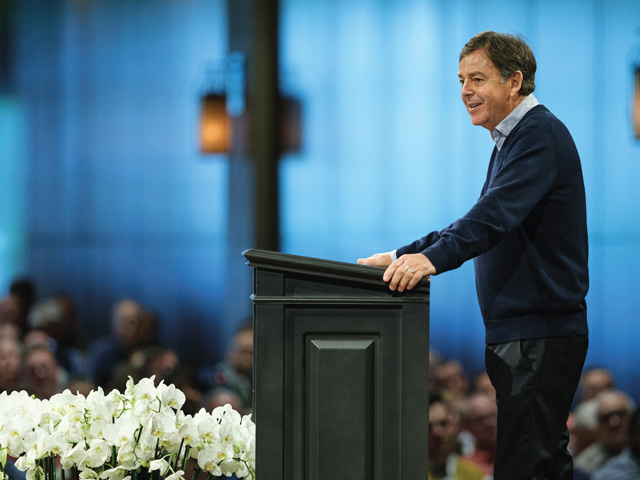
 The Pharisees searched Scripture and studied the prophecies concerning the promised Messiah—yet they failed to recognize Him! Could you be biblically knowledgeable yet spiritually blind like them? Find out as you listen to Truth For Life with Alistair Begg.
-----------------------------------------
• Click here and look for "FROM THE SERMON" to stream or read the full message.
• This program is part of the series A Light in the Darkness’
• Learn more about our current resource, request your copy with a donation of any amount.
• FREE AUDIOBOOK! In our polarized culture, disagreement is often seen as combative and offensive. What if there were a way to do it well? Download your free copy of The Art of Disagreeing by Gavin Ortlund and master how to disagree with kindness and influence. Request yours at ‘truthforlife.org/disagree.’
Helpful Resources
- Learn about God's salvation plan
- Read our most recent articles
- Subscribe to our daily devotional
Follow Us
YouTube | Instagram | Facebook | X
This listener-funded program features the clear, relevant Bible teaching of Alistair Begg. Today’s program and nearly 3,000 messages can be streamed and shared for free at tfl.org thanks to the generous giving from monthly donors called Truthpartners. Learn more about this Gospel-sharing team or become one today. Thanks for listening to Truth For Life!
Guest (Male): The Pharisees were the Bible scholars of their day. They searched the scriptures, they studied the prophecies concerning the promised Messiah, and yet, when he was right in front of them, they failed to recognize him. Is it possible that we could be biblically knowledgeable and yet spiritually blind like the Pharisees? Today on Truth For Life Weekend, Alistair Begg challenges us to take an honest look at our own response to the teaching of Jesus.
Alistair Begg: We turn this morning to John chapter nine, and we read from verse 39. We read these three verses and then we'll pray and study them together. Jesus said, "For judgment I have come into this world, so that the blind will see and those who see will become blind." Some Pharisees who were with him heard him say this and asked, "What? Are we blind too?" Jesus said, "If you were blind, you would not be guilty of sin; but now that you claim you can see, your guilt remains." Father, with our Bibles open before us, we humbly ask that you will come and by the Holy Spirit teach us from the Bible. Show us our Savior and show us ourselves, Lord, and then match us up for your glory and for our good. We pray in Jesus' name. Amen. In the British Parliament, when the time comes for its members to vote, they ring what is called the division bell. The division bell to which I refer is a bell that is sounded within the precincts of Parliament calling the members to a vote. Something similar happens in Congress, but there is no special name for it. The least I checked yesterday, there wasn't. It means that the members have about eight minutes to assemble themselves in the appropriate division lobby in order to vote for or against the resolution. And so the notion of the bell and the sounding of the bell immediately calls the question. Folks know it is decision time. I want to suggest to you that that is the most appropriate introduction that I can find for where we are this morning in relationship to these concluding verses of John chapter nine. Because by his coming into the world, Jesus, if you like, sounds the division bell. And this division is an inevitable division, and it is an unavoidable division. Indeed, the inevitable consequence of the coming of Jesus is just that division. To be confronted with the claims of Jesus is to find oneself at a crossroads. At a crossroads, one has to make a decision, and the way in which we turn defines so much that follows from it. And this division, we have learned, runs all the way through John's Gospel. Classically in chapter three and in verse 18, we noted it earlier in the study in John nine, "Whoever believes in him is not condemned, but whoever does not believe stands condemned already because he has not believed in the name of God's one and only Son." So what we discover is simply this: that the inevitable consequence of the presence of Jesus in the world is a separation. A separation between those who claim to have religious insight, even though they are in fact spiritually blind, and those who, conscious of the fact that they are blinded by sin, pray that they might be given the sight of which the sin inherent in their nature has robbed them. And this contrast is clearly seen in this chapter. We have spent, obviously, the vast majority of time looking at the incident concerning the healing of the man born blind. This man was awakened to the fact of his spiritual blindness. He might have thought that his greatest need in life was in order to have his physical sight restored, which, of course, Jesus had done. But when all is said and done, Jesus seeks him out in order to ask him a question. The question that is found in verse 35: "Do you believe in the Son of Man?" And the response of the man is eager. He is genuinely interested. "Who is he, sir?" the man asks. "Tell me so that I may believe in him." And he stands in direct contrast to the Pharisees who refused to see what was right before their noses. They were the ones who claimed to have the sight, but they were in fact the ones who were blind to the truth. So I say to you again, to be confronted by the teaching of Jesus is to find oneself standing at a crossroads. And this is not a truth that is tucked away in corners of the Bible, but actually simply stands, as it were, in strategic positions all the way through the Gospel records. I was talking with someone earlier this morning about a baby that was born on Friday, and I was thinking of all the joy that is in that and people taking the little girl in their arms and making pronouncements about how her little features are and who she looks like and perhaps what she will become. And over the years, we have all engaged in that and observed that, and we've heard all kinds of things said about the children held in the arms of an older person. But none of us, I would suggest, have ever heard anybody take a child in their arms and say what Simeon said when he took the child Jesus in his arms on the occasion that Mary and Joseph brought him for dedication at the temple. Listen to what he said when he took the child Jesus in his arms: "This child is destined to cause the falling and rising of many in Israel, to be a sign that will be spoken against, so that the thoughts of many hearts will be revealed." What a strange thing to say about a baby. A thing that could be said really about no other child, for there is no other who fulfills the role that Jesus fills. But the Pharisees refused to see this, and they did not like the division that was suggested. Jesus had declared that he didn't come into the world to condemn the world. We saw that back in verse 17 of chapter three, but he came to save. This is not some kind of contradiction in verse 39. Jesus said, "For judgment I have come into this world." Some bright spark said, "Well, I thought he said that he didn't come for condemnation." That's exactly right. He didn't come for condemnation, but judgment is an inevitable consequence of the coming of Jesus. When the light shines, when the division bell sounds, as it were, those who come to the light find it to be the light of life, while those who refuse the light turn away into deeper darkness. Now, it is for this reason that I have said to you in the past what I remind you of again now, namely: that it is a dangerous thing to sit and listen to the preaching of the Bible in church. And the reason it is dangerous lies in the fact that if the teaching of the Bible, if the proclaiming of the good news does not soften your heart, it will harden your heart. If the teaching does not draw you to Christ, it will inevitably drive you from Christ. When you resist the truth when it is made clear to you, you leave the preacher with only one option, namely: to try again and the next time to try and say it even more plainly than before. And in doing so, the preacher then exposes the listener to the risk of a further rejection of the good news, and that listener never knows when that rejection will prove to be the point at which their heart is hardened beyond recovery. I say to you that if in listening you remain unconverted, you are in a dangerous, vulnerable position. That's the significance, is it not, of what we read as a sort of parallel passage in our scripture reading from Isaiah chapter six? If you care to turn to it, I'll remind you of it. If you don't, I'll quote it for you. Most of us when we read Isaiah six only go as far as verse eight: the declaration of God, the revelation of himself, the response of Isaiah in humility and in contrition and in penitence, the question of God, "Who will go for us and who will I send?" the response of Isaiah, "I'll go for you. Will I do? I will go for you." And then usually that becomes the basis of a missionary talk and calling people to serve Jesus and to go out. And a very valid missionary talk it is. But it goes on to verse nine because once Isaiah says he's prepared to go, what a strange commission he receives. And God said, "Go and tell this people: 'Be ever hearing, but never understanding; be ever seeing, but never perceiving.' Make the heart of this people calloused; make their ears dull and close their eyes. Otherwise, they might see with their eyes, hear with their ears, understand with their hearts, and turn and be healed." What a strange thing to say. What a bizarre commission to be given to a prophet. How are we to understand that? Well, we're helped when we look at the five or so occasions in the New Testament where Isaiah six is quoted. But we're also helped by considering the way in which Isaiah responded to that commission. What did he do? Did he take that commission and say, "Okay, I get it. What I'm supposed to do is make the story so complicated that most people won't be able to get it. Make it so complex and so convoluted that folks will be going, 'Oh, I don't understand that at all.'" No, he didn't do that. What did he do? He made a commitment to clarity and simplicity, so much so that in chapter 28 of Isaiah, the reaction of people to his prophetic ministry is to say, "Why is he treating us like kids?" Verse nine of Isaiah 28: "Who is he trying to teach? To whom is he explaining his message? To children weaned from their milk, to those just taken from the breast? Why are you coming and speaking so plainly? Speaking as if we were children, talking to us in such ABC language?" Well, you see, he understands that by teaching with this clarity and with this simplicity, the imperatives of nine and ten in chapter six become the inevitable outcome of his ministry. That if the Word of God does not shine in to soften, it will shine and it will bake your heart and harden it. If the rain of God's Word does not irrigate your soul and soften it up to receive the seed that is planted, it will harden it and make your heart like a corrugated tin roof. If God's Word won't save you, what will? Some people are waiting for their own personal miracle, their own personal intervention. And what John tells us in chapter 12 is that even after Jesus had done all of these miraculous signs, still they did not believe in him. And then he goes on to quote exactly Isaiah chapter six, verses nine and ten. It's the same thing that you have in the story that Jesus tells of the rich man and Lazarus. Remember? And the rich man dies and goes to hell and looks over and can see Lazarus. It's a picture, it's a metaphor. And he cries out that there would be intervention in the lives of his brothers. And the response is, there's no point in anybody going to your brothers. Because if they will not listen to Moses and the prophets, then they will not listen even though someone should rise from the dead. In other words, the confidence of heaven is in the scriptures. That's why James says, humbly accept—James 1:21, I think from memory—humbly accept the word planted in you that can save you. Today, if you hear God's voice, do not harden your hearts. If you think for a moment that you can hold the Gospel as it is preached to you at arm's length in some kind of intellectual, critical detachment, then your very posture reveals the blindness of your own mind. Jesus said, "For judgment I have come into this world so that the blind will see and those who see will become blind." There is a division then that is inevitable. Then we come in verse 40 to the question asked by the Pharisees, which is a revealing question in so far as it reveals how they saw themselves and it reveals how they viewed Jesus. Some Pharisees who were with him heard him say this and asked, "What? Are we blind too?" "You're not suggesting that we're blind, are you, Jesus? You're not actually suggesting that we need to come to you so that we might have our sight restored." It doesn't occur to these characters that they could possibly be blind. It never does to people who are blind, you see. One of the indications of your blindness is that you don't think you're blind. The indication that you're on the way to sight is in the awareness that you're blind. The first thing that the Bible does when the light shines is shows up the darkness. And when the light shines in and shows up our blindness, then we know unless someone makes me see, I am to remain forever blind. But the greatest blindness is the blindness that is wrapped up in religious formalism, such as represented here by these Pharisees. They regard themselves as the guides of the blind. You can read that in Romans two. They regard themselves as a light that shines to those in the darkness. They regard themselves as instructors of the foolish. Paul mentions all of that when he is arguing to the point in Romans three where he says and so the whole world is accountable before God, whether you are a Gentile coming from that background or whether you are a Jew feeling yourself to be the custodians of all this truth. And so it makes their question all the more striking, doesn't it? One can almost hear the sneer on their faces. "What, are we blind too?" Sense the smugness of their tone. Catch a flavor of the derision directed at Jesus. You can just see this. You know that horrible feeling when you're in a room somewhere and everybody else thinks they're in the know, and they ask a question and they are just dissing you, and they look at one another like, you know, and you just feel so small and so impoverished by it all. That's what they're doing. They're looking at one another going, "So we're blind too, are we, Jesus? Yeah." But blind they were. So blind they didn't know how blind they were. They're like the man in Luke 18. Remember the wonderful parable Jesus tells of a Pharisee and the tax collector? "And to those confident in their own righteousness and who looked down on everybody else," Luke says in Luke 18, Jesus told a story. Context is clear, isn't it? To those who were confident in their own righteousness, to people who were sure they could see, to people who were dead certain that they were not the blind people. To those who were confident in their own righteousness and looked down on everybody else, all those poor people who can't see, Jesus told a parable. "There were two men went up to the temple to pray. One was a Pharisee and the other a tax collector." The people nudging one another, "Here we go. Good guy, bad guy. The classic Jesus story. There's a good fellow and a bad fellow. I wonder what this one's about." "And the Pharisee stood up and prayed about himself: 'God, I thank you I'm not like other men—robbers, evildoers, adulterers like this tax collector here. After all, I fast twice a week, I give a tenth of all I get.'" People would be going, "That's pretty good. Pretty good." Giving him marks out of ten. Jesus said, "But the tax collector stood at a distance. He would not even look up to heaven, but he beat his breast and said, 'God, have mercy on me a sinner.'" And then the sting in the tail. Jesus says, "I tell you that this man, the tax collector, went home justified before God. For everyone who exalts himself," like the Pharisees who think they can see, "will be humbled, and whoever humbles himself will be exalted." Do you remember the Simeon statement now, holding the baby in his arms? What did he say? "This child is destined for the falling and rising of many in Israel." Until a man or a woman falls at the feet of Jesus and says, "I am a blind man, I am a blind woman," they will never rise to see. As long as we sit in the supercilious perspective of the religious formalist declaring, "You know, I have been around church for a long time. My uncle Jim gave me a Bible when we were married. I know that because I saw it just the other day, hadn't seen it for years, but I know it's somewhere." All that kind of thing. "I'm so glad that I don't need to trust in Jesus. I'm so glad that I'm like the Pharisee in this story. I'm not like other men. And actually, I've really upped my contribution since I came here as well, although I don't expect you to know much about that." Jesus turns the whole thing on its head. "Oh, you're not suggesting that we're blind, are you, Jesus?" You see, our response to Jesus shows what we think of ourselves. And our response to Jesus shows what we think of Jesus. And what they think of Jesus is just actually that he is deluded, that he's a madman, that he's demon-possessed. We saw that before. It comes again in chapter 10. "Why listen to him?" they said. "He's demon-possessed and raving mad." And that for me is one of the great and intriguing things. How it is that people continue to come and listen to the Bible being preached, and actually you've already made your decision concerning Jesus. You've decided that Jesus was either deluded or he was deceitful. Unless you move from one of those two positions to acknowledge that he is who he is, that he is the light of the world, and that those who follow him will not walk in darkness, then you walk out into a darkness that is just complete, utter darkness. Now, look at how Jesus answers. Verse 39, there's a division. Verse 40, there's a question. And verse 41, there's an answer. The answer that he gives is a puzzling answer. It's certainly not an easy little verse, is it? They were probably expecting Jesus to say, "Yes, you are a blind bunch," or, "No, of course you're not blind. You're the Pharisees. You have all the news strapped around your wrists and fastened on your forehead. You've got all the Old Testament scriptures right there, right at your hand." They probably expected either a yes or a no. But instead of doing that, he does what he does so often, and that is he just reaches in and twists their noses a little bit by responding in what is a paradoxical fashion. Now, let me just quote to you a Phillips paraphrase of this verse because I think it will help us get the sense of it. Phillips paraphrases verse 41, which here reads, "If you were blind, you would not be guilty of sin; but now that you claim you can see, your guilt remains." It's like a really bad riddle, isn't it? You can say it to yourself 15 times in a row and still not get it. But listen to how Phillips does it. "If you were blind," returned Jesus, "nobody could blame you. But as you insist 'We can see,' your guilt remains." If you were blind, you couldn't be held accountable for your ignorance. That's what he's saying. "But since you insist you can see, your guilt remains." And before their very eyes, Jesus has done what God alone can do. If they'd been without any understanding of spiritual things, then of course they wouldn't have been blameworthy. But because they have a knowledge of this stuff, they're culpable because they are unwilling to see beyond the horizon, as it were, of the Old Testament.
Bob Lepine: You’re listening to Truth For Life Weekend, that is Alistair Begg with a message titled, “Are We Blind Too?” We’ll hear the conclusion of this message next weekend. Alistair mentioned today how dangerous it is to continually listen to God’s Word preached while remaining unconverted. And if that describes you, I want to encourage you to visit our website truthforlife.org/thestory. There you’ll find a brief video of Alistair explaining the gospel. You’ll also find short series that address remaining questions you may have. You can watch or listen to as many of these messages as you’d like, all of it’s free. And as we’re learning, it’s vitally important for us to teach God’s Word with clarity and with relevance. In fact, if you’re in pastoral ministry, or if you’re a ministry student, there’s still time to register to attend the 2026 Basics Conference September 29th and 30th in Southern California. There are discounts available for students. To register, visit basicsconference.org. I’m Bob Lepine, thanks for studying the Bible with us. Meeting Jesus eventually brings us to a crossroads moment. Which way will we turn? Next weekend we’ll explore the options and their consequences. The Bible teaching of Alistair Begg is furnished by Truth For Life, where the learning is for living.
Related Episodes
Sexual Purity (Part 2 of 2)
Friday, August 21
Sexual Purity (Part 1 of 2)
Thursday, August 20
Pleasing God
Wednesday, August 19
About Truth For Life
Truth For Life distributes the unique, expositional Bible teaching of Alistair Begg. Studying God’s Word each day, verse by verse, is the hallmark of this ministry. In a desire to share the good news of the Gospel without cost as a barrier, the entire teaching archive is available for free download and resources are available at cost with no markup.
About Alistair Begg
Alistair Begg has been in pastoral ministry since 1975. Following graduation from The London School of Theology, he served eight years in Scotland at both Charlotte Chapel in Edinburgh and Hamilton Baptist Church. In 1983, he became the senior pastor at Parkside Church near Cleveland, Ohio. He has written several books and is heard daily and weekly on the radio program, Truth For Life. The teaching on Truth For Life stems from the week by week Bible teaching at Parkside Church. He and his wife, Susan, were married in 1975 and they have three grown children.Contact Truth For Life with Alistair Begg
Website
http://www.truthforlife.org/?utm_source=oneplace&utm_medium=sitelinks&utm_campaign=home
Mailing Address
Truth For Life
P.O. Box 398000
Cleveland OH 44139
Telephone (Customer Service)
888-588-7884 Domestic
400-543-6800 International
440-543-0522 ( Fax)


